
by Gabe Veltri, a member of the 2024 Stream Team
We pulled up to the stream site and parked on the side of the road, our car surrounded by trash and broken glass. From the outside, the stream didn’t seem promising. It ran alongside the road before disappearing into a culvert, hidden by a steep, overgrown bank. As we climbed down to the water, we started taking bets on the B-IBI score of the stream—that’s the score we use to measure stream health. Numbers in the 20s and 30s were thrown around; none of us expected much. But as we stepped into the water to take our sample, the stream started to surprise us.
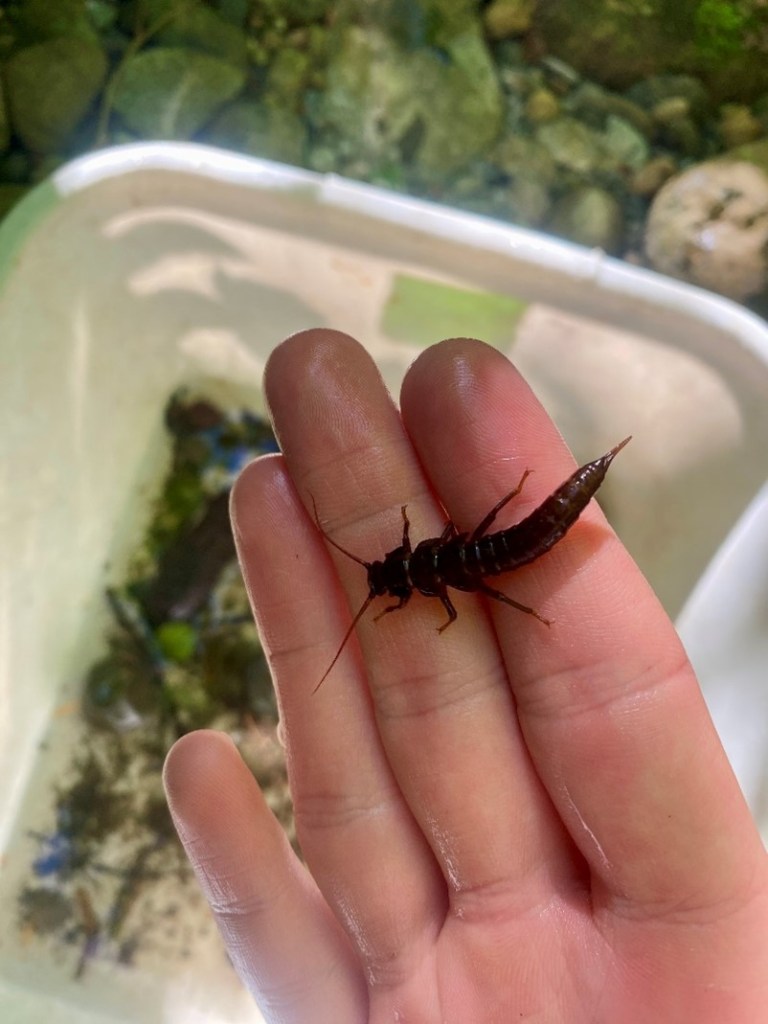
In the shaded pools among downed trees, we spotted small fish darting back and forth: juvenile salmonids. When we finally dumped our sample out onto the tray, the stream came to life. Massive stoneflies crawled among the rocks along with hundreds of other benthic macroinvertebrates— the “stream bugs” that tell us so much about a stream’s health. It was one of those moments where everything clicked. Even here, hidden on the side of the road, this little stretch of shaded water was teeming with life.

Counting stream bugs
Moments like these drive the Stream Team, a group of dedicated researchers who monitor streams all across King County. Streams are commonly monitored for bacteria, nutrients, water levels, and even salmon spawning activity. Each piece of data contributes to the bigger picture and helps policy makers and scientists understand and conserve our local watersheds.
But our team focuses specifically on sampling aquatic macroinvertebrates.
“Aquatic macroinvertebrates – or stream bugs – are important prey for fish and are also excellent indicators of overall stream health,” says Kate Macneale, supervisor of the Freshwater Benthic Macroinvertebrate Monitoring Program. “When streams are impacted by flashy flows, contaminants, and other stressors that come with urban development, we see declines in the number and types of aquatic macroinvertebrates present in the stream. In tracking those declines and shifts in the bug community, we can track how well streams are supporting the aquatic community that relies on those healthy habitats.”
The bugs collected are run through the Benthic Index of Biotic Integrity (B-IBI), a scoring system. B-IBI uses the number and variety of bugs to rank streams on a scale of 0 to 100, where higher scores indicate healthier streams. Our monitoring program has been running since the late 1990s so, in some locations, we have over 25 years of data that help us understand how streams are changing over time.
Sampling can only happen during the summer after the rains slow down and stream flows drop, but before salmon return to spawn. To complete the work, a group of seasonal employees is brought on each year. This year I was lucky to be part of the Stream Team.
The 2024 Stream Team
The 2024 Stream Team had five people: a mix of college students, recent graduates, and seasoned fieldworkers. We were led by Diane, who kept everything running smoothly. Sometimes, we worked all together, but usually, we split into pairs to sample as many sites as possible.
Working on the Stream Team means no two days are ever the same. In a summer of fieldwork, we sampled over 200 stream sites across King County. That meant wading through some of the clearest, coldest streams in the mountains and trudging through degraded city streams filled with garbage. What struck me most was that, even in the most polluted streams, we still found bugs. Life was always there.

Getting to work
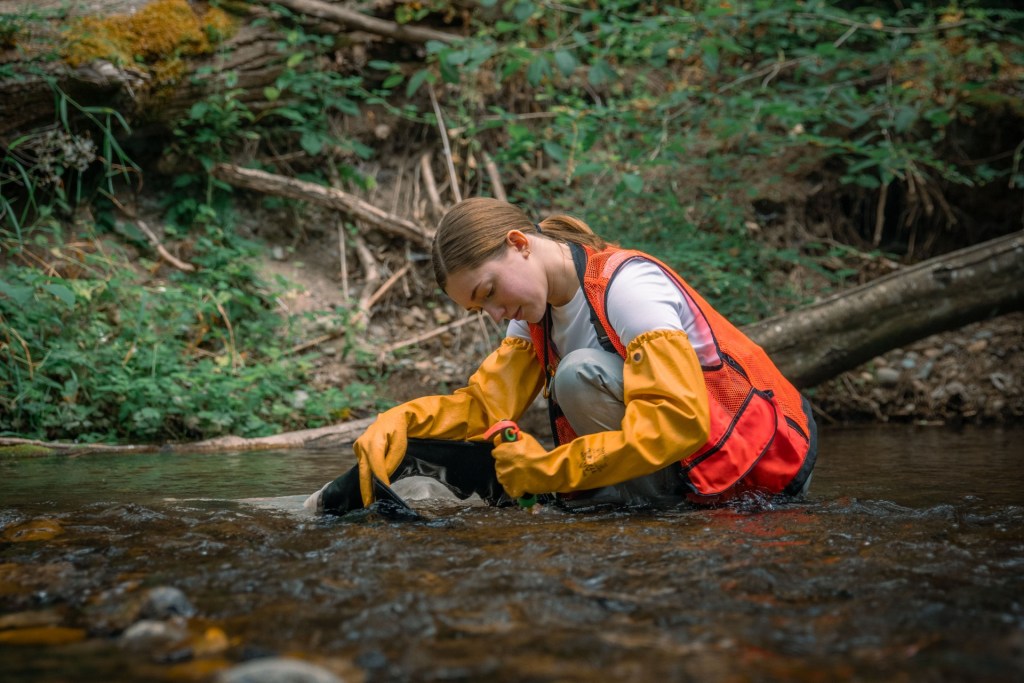
Each day started by navigating to the site using notes from previous years—sometimes straightforward, sometimes an adventure. Once at the water, the first task was identifying the riffles. These are shallow areas where the water moves over rocks and is broken at the surface almost like a sheet of ruffled potato chips.
Armed with a Surber net and a garden weed tool, we collected our sample. The process is quick: place the net facing upstream, disturb the sediment in front of it for a minute, and let the current carry all the bugs into the net. We repeated this eight times, carefully checking the net for fish, salamanders, lamprey, or frogs that might be trying to hitch a ride. Afterward, we dumped the net into a tray to see what we’d found—one of the most exciting parts of the job.
The first time we did this, I couldn’t believe how much life existed in just eight square feet of streambed. Hundreds of creatures wriggled around—mayflies, caddisflies, stoneflies—even the occasional crayfish. Although we could look at the sample for hours, we were on a strict deadline, with 4 to 5 sites to visit per day. We bottled the sample, picked any stragglers out of the net with tweezers, and hiked back to the car to spray off our boots and head to the next site.
A summer to remember
Before the end of the season, I asked Diane what the best and worst things about working on the Stream Team are. “The best thing,” she said, “is getting to work with and meet the coolest early career scientists, even if it’s only for a few months. The worst thing is when they leave.”
Working with the Stream Team was short, but it’s an experience I’ll take with me for the rest of my life. The hidden pockets of life in our streams, the problem-solving, the team itself—it’s something I’ll always remember.
Note: ChatGPT was used to develop the original outline for this story.
OpenAI. (2024). ChatGPT [Large language model]. Retrieved from https://chat.openai.com
Want to learn even more about stream bugs and stream health in King County? Check out the video below!


