“What are you doing?”
“Why are you doing that?”
“Who are you?”
There are lots of answers to the first two questions (and we’ll use this blog to talk about them!) but the last one is easy:
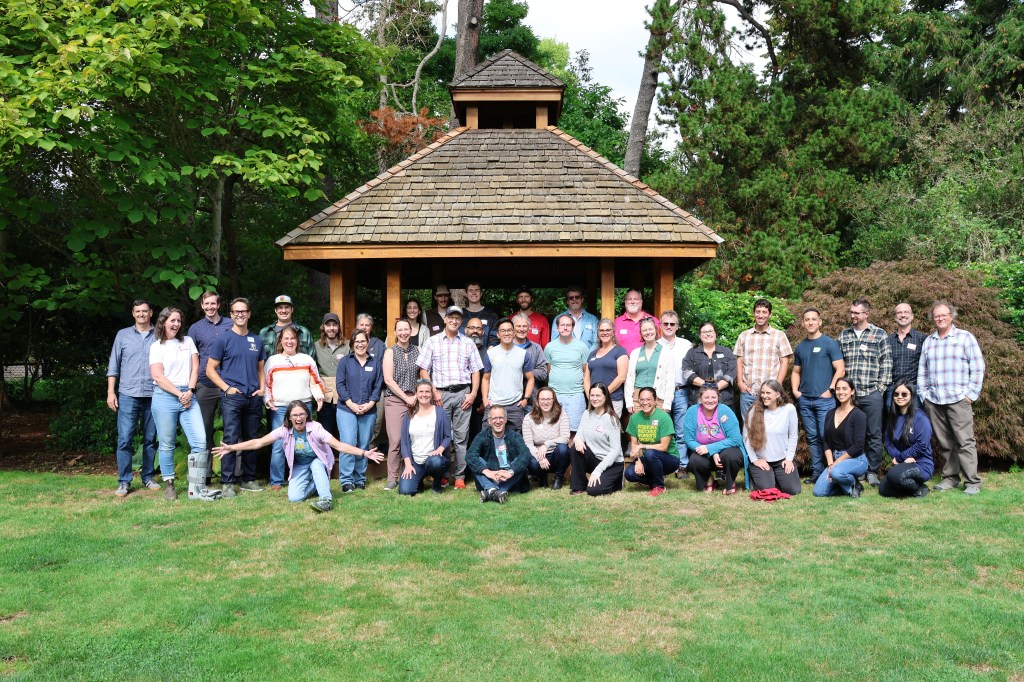
We are the Science Section, a team of researchers in the Water and Land Resources Division (WLRD) in King County’s Department of Natural Resources and Parks (DNRP). We study water, land, and wildlife to improve health and habitat for people and animals. Our team is exploring some of today’s most pressing environmental questions… and finding answers that can make things better right now and in the future.
Putting science to work
In the face of an uncertain and rapidly changing environment- in the region and across the globe- we need science to test ideas, guide actions, and prioritize how we spend time, money, and energy. The Science Section’s work supports a wide variety of King County’s environmental and public health programs, including those that address:
- Salmon and biodiversity
- Harmful freshwater bacteria and algae
- Toxic contaminants in water, soil, and fish
- Habitat management
- Wastewater and stormwater
- Land use and/or development

Collaborating across -ologies
We help King County uphold a commitment to deliver clean water and healthy habitat for people, salmon, and orca in a generation. This means planning and performing different types of research that reveal new information about what’s happening in our environment, including emerging concerns and success stories alike. Our team brings together a wide array of expertise, allowing us to collaborate and innovate across many fields of applied science, including:
- Biology
- Chemistry
- Ecology
- Engineering
- Geology
- Hydrology
- Limnology
- Modeling
- Oceanography
- Programming
- Statistics
- Toxicology

Any given workday
With so many questions to answer and solutions to find, our researchers stay busy at the office and in the field. As you visit King County’s parks, beaches, lakes, and trails, keep an eye out for our researchers and their gages, sensors, nets, buckets, cameras, and, of course, safety gear! You might spot us…
- Monitoring lakes for dangerous bacteria and algae
- Counting bugs to determine the health of our streams
- Helping people make safer choices about where to fish and which fish to eat
- Investigating the impact of beavers on ecosystems and infrastructure
- Analyzing the success of restoration projects on fish habitat
- Revealing the reduction of harmful chemicals in lake sediment
You can also find members of the Science Section wading through wetlands, counting salmon, installing stream monitors, speaking with students, and so much more- all to better understand and improve natural and restored habitats across the county.

Inquiring minds
Asking questions is a big part of our work. If you have questions about water, land, wildlife, and science in King County, please get in touch!