It’s cold and dark when we head to the beach. The mussels in the trunk have been on the road – and on ice – all day. This morning, ecotoxicologist and shellfish chauffeur Jennifer Lanksbury picked them up from a partner in Penn Cove and now we’re squeezed between two deadlines: these native bay mussels (Mytilus trossulus) can only be out of the water for 12 hours, and they must go back in at exactly the right moment.
The mollusks are key players in the Mussel Watch program, a regional effort led by the Washington State Department of Fish and Wildlife. The program combines the powers of people and mussels to track toxic contaminants in Puget Sound, and our group is just one of many working in sync to deploy mussels at more than 80 sites. We’re all racing the rain, the clock, and the tide.
How mussels help us track pollution in Puget Sound
Mussels are shellfish that live in freshwater and marine habitats. They filter large amounts of water through their gills to grab tiny snacks like phytoplankton and algae. When toxic chemicals contaminate that water, mussels absorb the chemicals and store them in their soft bodies. By doing so, these powerful living filters actually improve water quality in some environments. In other settings, they act as sensors that help scientists understand local contamination through biomonitoring. (Click here to explore the ‘Biomonitoring of Contaminants in the Puget Sound Nearshore’ Storymap from Washington Department of Fish and Wildlife (WDFW)!)
In this region, we’re tracking pollutants that can harm people and animals, including polycyclic aromatic hydrocarbons (PAHs), polychlorinated biphenyls (PCBs), metals, pesticides, and 6PPD-quinone (6PPDQ). These contaminants come from cars, farms, industry, and other human activities. Then stormwater runoff, emissions, and spills carry them into our waters, including Puget Sound.
By analyzing the tissue of mussels from one time or location, scientists can determine which of these pollutants are present and how concentrated they are. Then by comparing samples from different times or locations, we can see where pollution levels are changing or holding steady and look for causes and solutions.

Get in, scientists, we’re going biomonitoring
Before our batch of mussels can begin collecting data, we have to get them in the water. Our team has two assigned locations in Seattle and a small window of time when conditions will be just right for deployment.
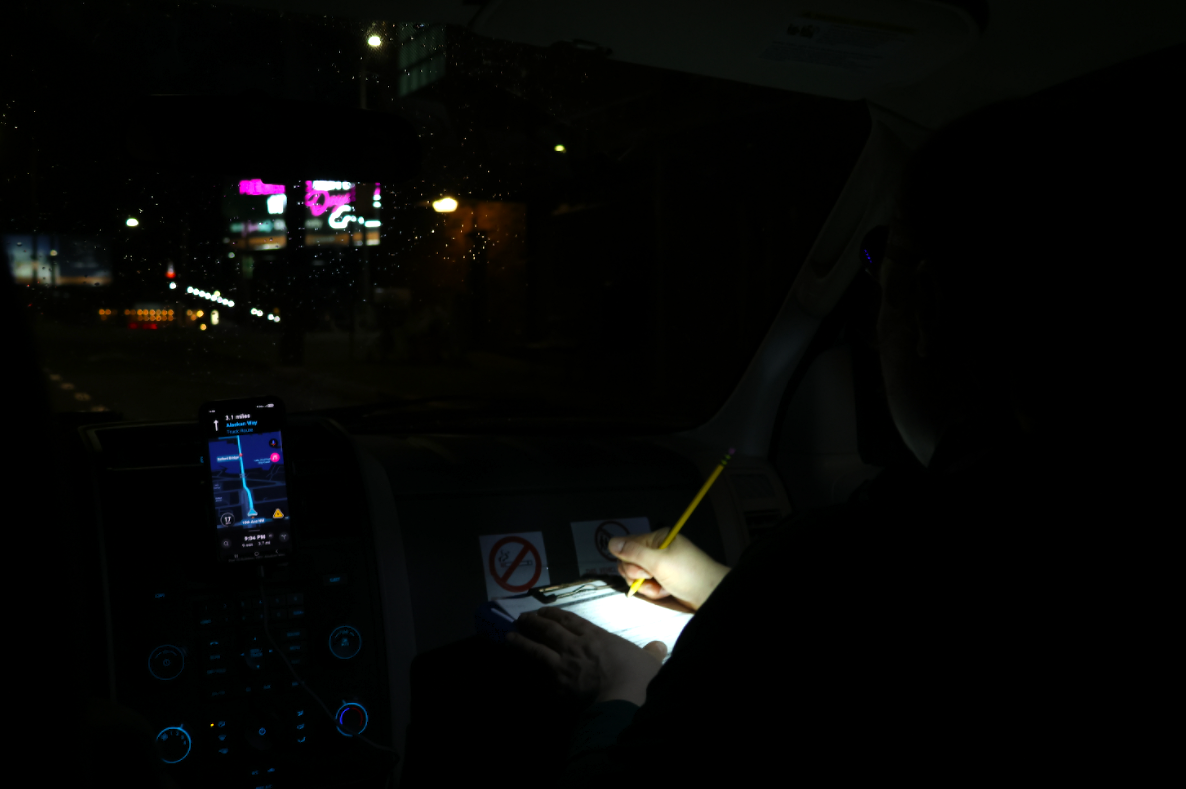
The trunk of our vehicle is at capacity. The mussels in the ice chest are surrounded by cages, cinderblocks, helical anchors, rebar, zip ties, labels, headlamps, tools, and a sturdy red wagon to ferry everything to each site. Jennifer Lanksbury drives as Chelsea Mitchell, another Science Section ecotoxicologist, helps navigate. In the back seat, camera equipment and raingear fill the space between Maxene, a student on a job shadowing assignment, and me, the Science Section’s in-house science communicator.
Our mission is clear:
- Find the assigned location and wait until zero tide. This is important because it allows for better comparison across sites. By anchoring our mussel cages at the water line when the tide hits zero feet, we ensure their placement is synchronized with all the other mussel cages being deployed around Puget Sound tonight.
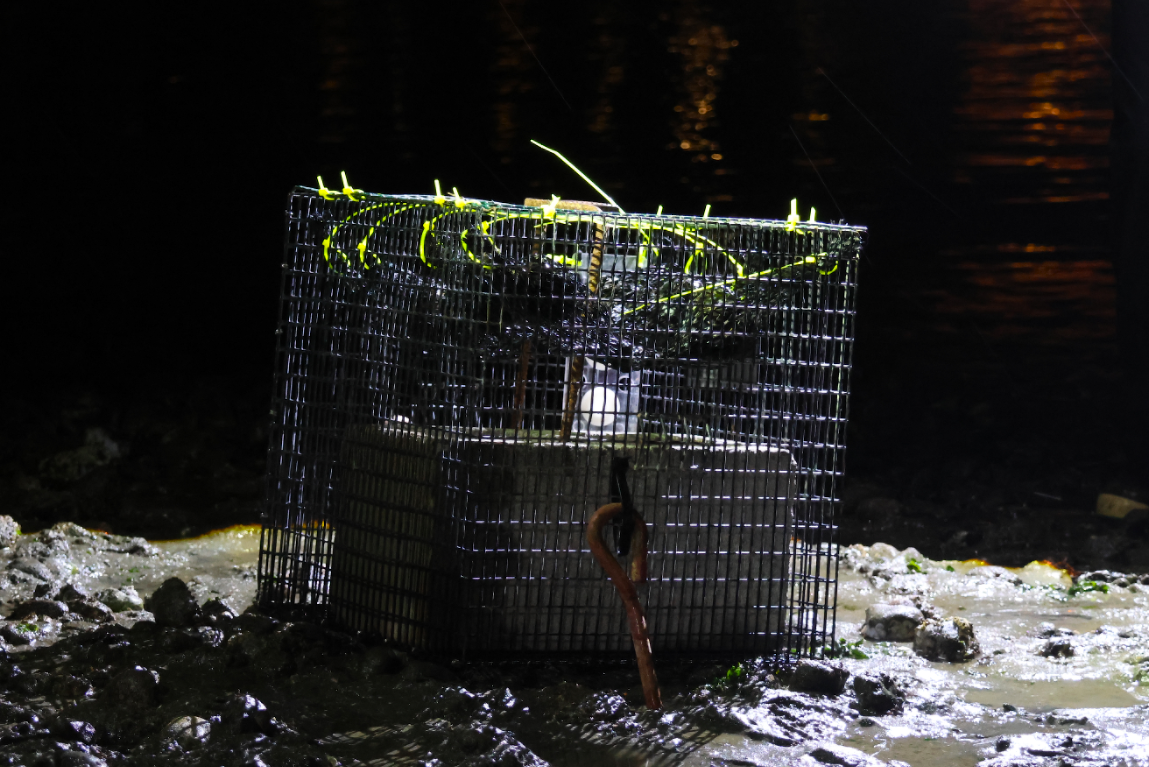
- Install a small metal cage on the beach using a cinderblock, rebar, and helical anchors to hold it in place. (This is where we’ll put our own muscles to work.)
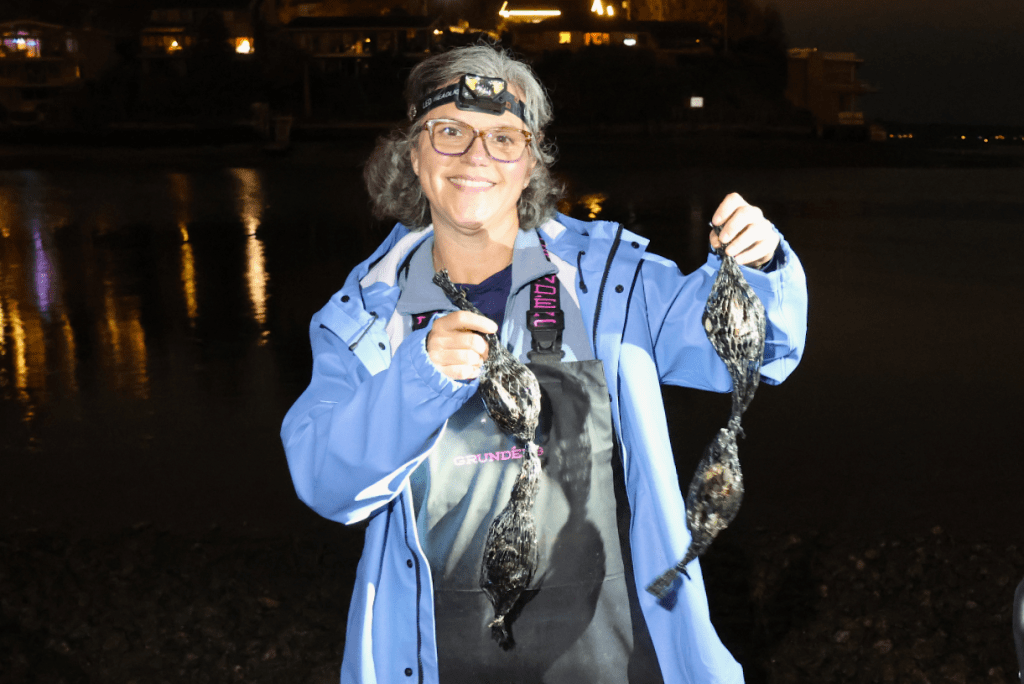
- Carefully suspend four mesh bags of mussels across the inner upper half of the cage. “Sea stars love to eat mussels, but they are a little lazy,” Jennifer tells us. “If they break into the cages and the mussels are elevated, the sea stars don’t try very hard to reach them.”
- Mount a small device called a diffusive gradients in thin-film (DGT) passive sampler in one corner of the cage. The DGT will absorb a toxic tire chemical called 6PPDQ and give us new data about this contaminant in marine environments.
- Lock and label the cage so the mussels stay in, hungry creatures stay out, and curious humans have a way to learn more about the project.
- Fill out a data sheet to track information about the location, timing, conditions, and other noteworthy details of the deployment.
Then head to the second site and do it all over again.
Deploy the mussels!
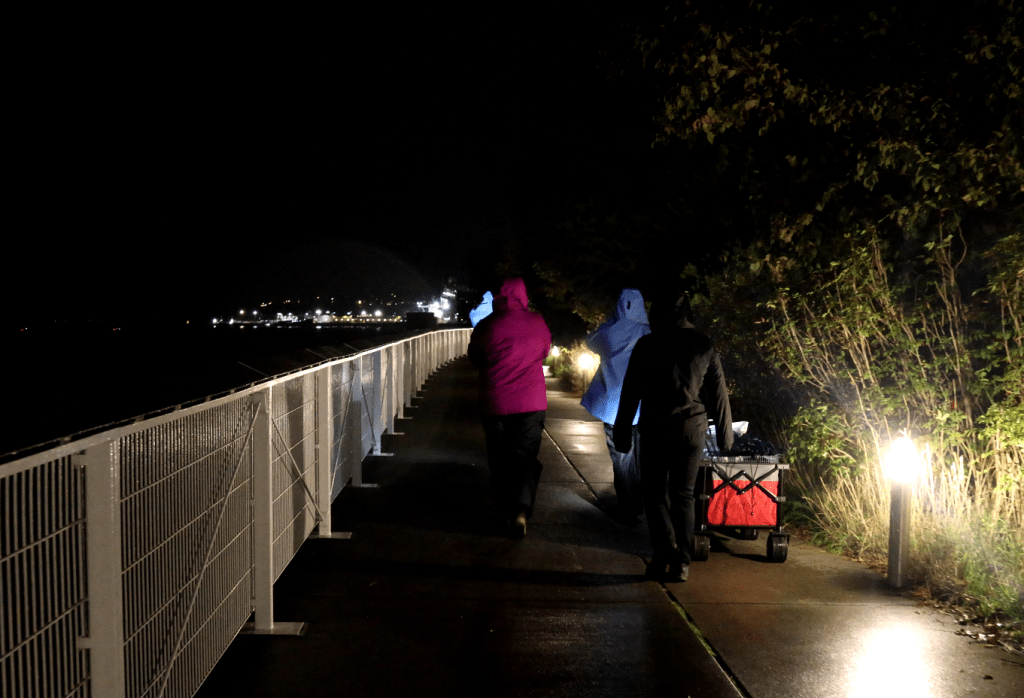
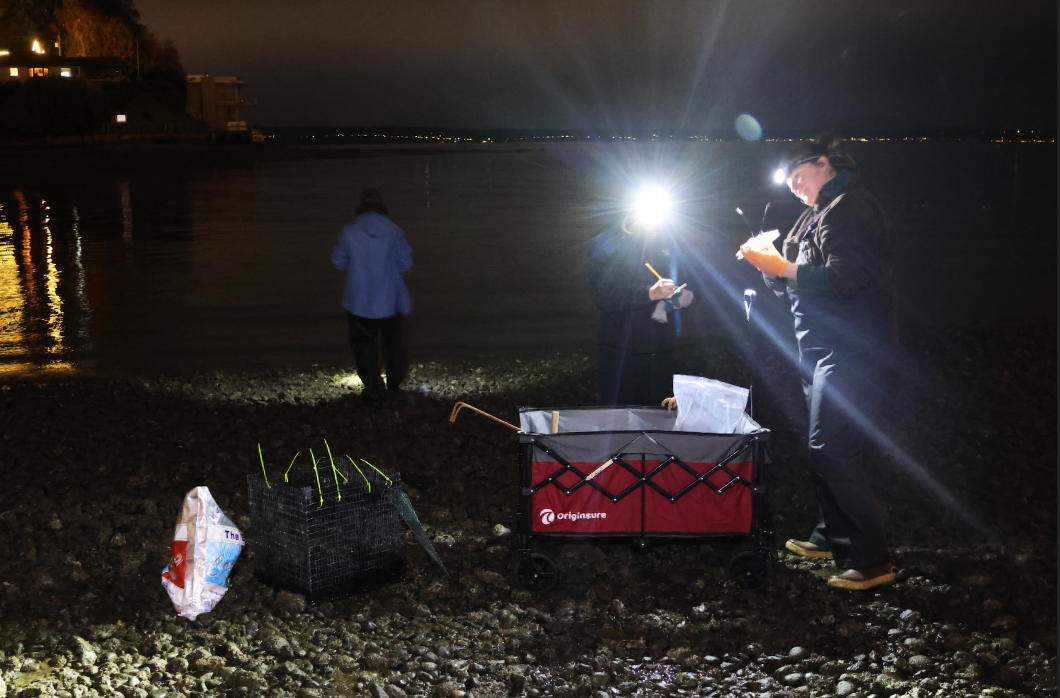
After a short drive north through Seattle, we arrive at our first mussel deployment location: Shilshole Bay. We move gear from the trunk to the wagon, mindful of the dark clouds above and the timing of the tide. The rain could start any moment, and we’ve got a long slippery walk ahead with lots of heavy equipment. After we scramble down to the unlit beach, we make our way over smooth round rocks until we find the right spot. The location is GPS-confirmed. The tide is zero. The time is right.
Jennifer and Chelsea explain the process and equipment while they install the cage, mussels, and DGT as quickly as possible. A sea lion groans somewhere in the darkness and a flock of Canada geese lands in the water nearby, all honks and splashes. Jennifer and Chelsea lock the mussel cage, attach a label, and take notes. Then we make our way back to the car with a much lighter load.

Meeting the new neighbors
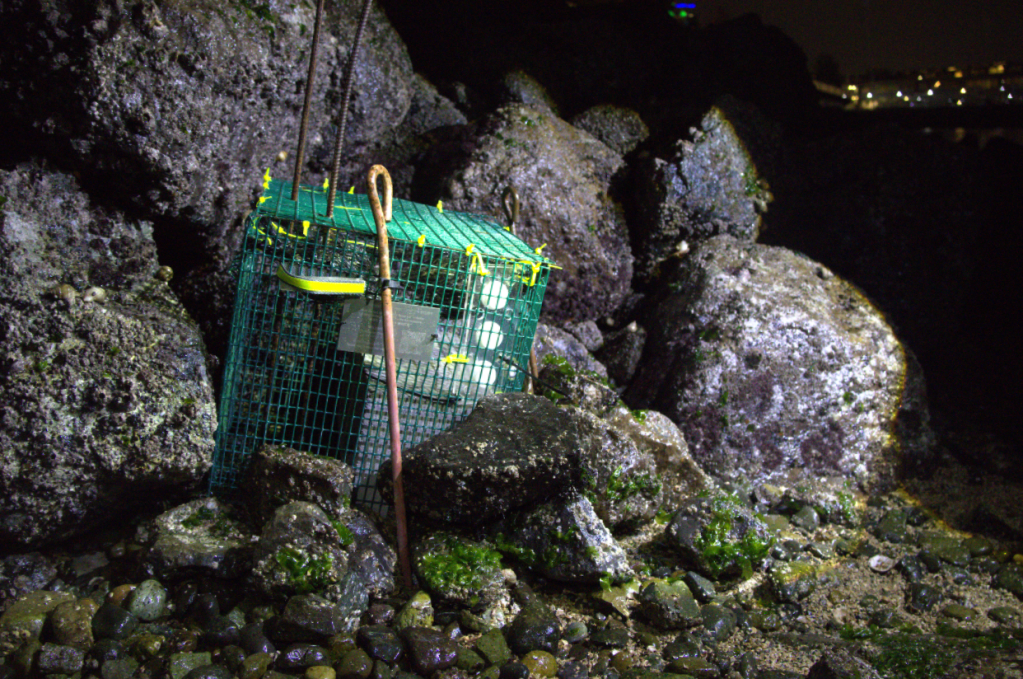
Our next stop is Myrtle Edwards Park. We fill the wagon again and start walking – this time on the paved Elliott Bay Trail. At the beach, we abandon the wagon, climb over driftwood, and locate the deployment site. Now it’s raining, which does nothing to discourage the swarms of tiny flies drawn to our headlamps. This site is tougher, with rock armoring that resists the anchor and rebar. Good thing we brought a sledgehammer!
As Jennifer and Chelsea work on the cage, I look away from the headlamps and across the water toward West Seattle. Once my eyes adjust to the darkness, I notice the jagged crevices at my feet that create such good homes for snails, anemones, and… sea stars everywhere. We are surrounded by mussel-munching echinoderms! This area will put our anti-predator mussel cage to the test.
After Jennifer tightly secures the cage lid with neon zip ties, I take a few more photos for our WDFW partners and it’s time to head home. As we drive, wet and a little quieter than before, I wonder what the mussels will tell us about Seattle’s nearshore waters.


What we’ve learned so far
Launched in the winter of 2012-2013 – by Jennifer Lanksbury herself – Mussel Watch volunteers deploy mussel cages every two years. The resulting data reveal that mussels near urban areas contain higher levels of toxic chemicals than those in less developed areas. Contamination hotspots are closely linked to human activity and stormwater inputs.
By identifying where toxic chemicals accumulate, Mussel Watch helps agencies prioritize restoration projects and evaluate the effectiveness of pollution-control measures. The baseline data will also be vital if we experience a catastrophic oil spill in Puget Sound. Knowing about conditions before a spill can guide clean-up efforts afterward and help us determine their effectiveness.
“This was one of the things we considered valuable about the program when we started,” notes Jennifer. “We even picked some of the original monitoring locations based on their higher risk for oil spill contamination.”
New year, new data
The mussels we deployed will stay in their cages, filtering water almost continuously, for three months. By early February, the shellfish will be back on the road, this time headed for a lab in Olympia. There, scientists will take tissue samples from each mussel and analyze them for multiple contaminants. The findings will give us a clearer picture of where conditions are improving and work still to do.
Programs like Mussel Watch make it easy to see connections between environmental health and human actions – negative and positive. Caring for Puget Sound requires rigorous science, data-driven policies, and everyday actions that reduce pollution. Also key? A strong volunteer community and lots of mussels.

Links and resources
- Contaminants monitored by Science Section ecotoxicologists | King County
- Toxics in fish and crabs | King County
- The Mussel Watch program | Washington State Department of Fish and Wildlife
- Stormwater runoff and pollution | King County