King County typically enjoys a reliable abundance of rainfall. And once it hits the ground, rainwater seeps into soil or runs along streets and parking lots, flowing into storm drains, and disappearing underground.
…Or does it?
In some parts of King County, stormwater can travel through miles of pipes, creeks, or both before finally emerging in lakes or Puget Sound. During its journey, stormwater can mix with the E. coli bacteria found in poop from people, pets, and wildlife. Poop-contaminated water can threaten community health and close swim beaches and shellfish harvesting areas.
To keep communities safe and healthy, King County’s Pollution Identification and Correction (PIC) Program works to find and fix sources of poop pollution.

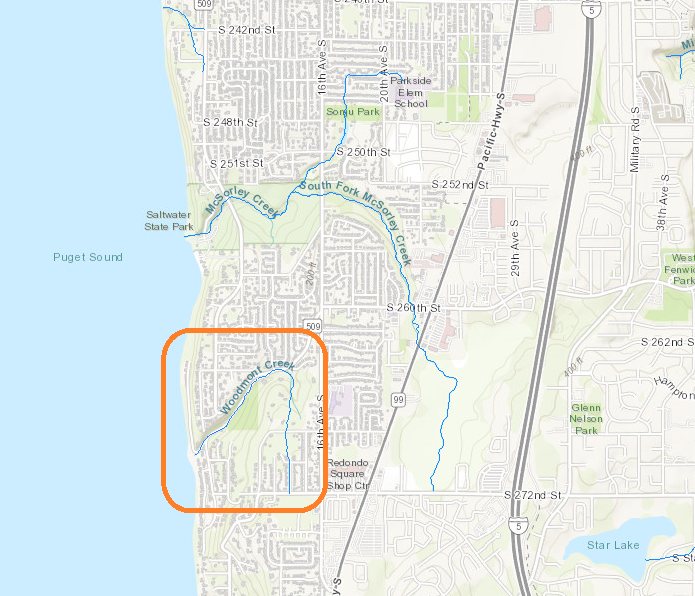
Woodmont Creek flows into Puget Sound
A mystery in Woodmont Creek
During water sampling events over the past several years, our team noticed something unusual in the Woodmont Creek basin in Des Moines. Jeremy Walls, Diane Yeh, and Cameron Chapman, three field scientists from the Water and Land Resources Division, had been collecting samples in the area’s stormwater system to understand where and how much poop pollution was entering the watershed.
Upstream, the water had very low bacteria levels, but downstream, the numbers suddenly spiked. A big increase signaled a big problem: somehow, poop was contaminating the stormwater system.
Following clues in the water
One possible contributor of high bacteria levels can be from sewage contamination. In many urban areas, homes are connected to sewer systems. This means there are pipes underground that take sewage from homes to local treatment plants. Many of the pipes in our urban areas were built decades ago. Over time these pipes can crack or become damaged, which means the sewage can leak out. When sewage leaks into the ground, it can enter nearby stormwater pipes and/or creeks.
By narrowing in on the area where bacteria levels in their samples shifted abruptly, the team knew the pollution had to be entering the stormwater system along one specific stretch of road. County staff tried to connect with nearby property owners to do more testing, but without being granted access to people’s homes and pipes, they needed another approach. It was time to bring in the robot.

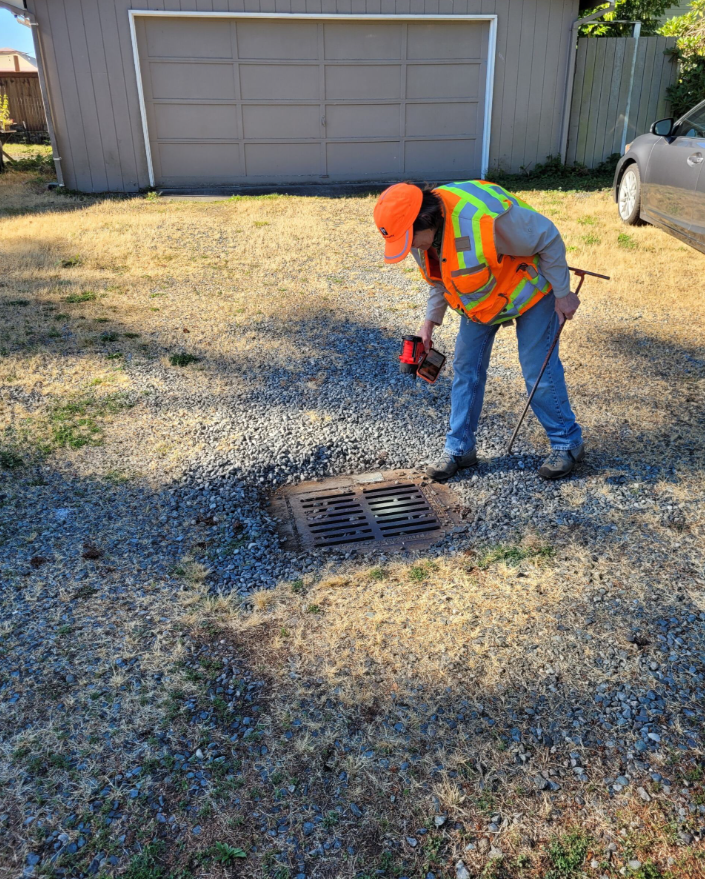

On the hunt: A member of the Pollution Identification and Correction (PIC) team looks for a possible source of contamination near Woodmont Creek
The right tool for the job
A closed-circuit television (CCTV) pipe crawler is a rugged, remote-controlled robot designed to explore underground pipes. The crawler has four main parts:
- A camera that can pan, tilt, and zoom to capture detailed video inside the pipe.
- A transporter, which is like a 40-pound remote controlled (RC) car that carries the camera through tight spaces.
- A long cable, often more than 1,000 feet long, that powers the crawler and sends video back to operator at the surface.
- A controller, which lets the operator steer the crawler and watch the live footage.
Using this equipment, the PIC team can inspect pipes from the inside without digging them up. When the crawler’s operator spots a problem like a crack, break, or strange flow of water, the crawler can mark the exact location in the pipe, so repair crews know where to go.

A break in the case
During the Woodmont Creek investigation, the crawler traveled down the stormwater pipe until it reached a section where suspicious water seeped in through a visible crack. A water sample was analyzed and test results showed high levels of bacteria.
The break in the pipe was a break in the case! The team marked the spot on the ground above the underground pipes so our partners at the City of Des Moines, who manage those stormwater pipes, could come back and fix it.
This one-minute excerpt shows the pipe crawler’s view as it explored the pipe and located the break. It’s helpful to have a robot that doesn’t mind dark, narrow, wet spaces… and spiders. (There is no sound with this video)
A speedy repair with downstream benefits
The King County team identified the location of the broken pipe, and the City of Des Moines repaired it to stop the leak. A contractor hired by City of Des Moines staff used a pipe‑lining technique to seal the damaged section from the inside, preventing significant disruption to the ground – and the community – above the pipes.
After the repair, the PIC team returned to take new water samples and the results were dramatic: the bacteria dropped to nearly non‑detectable levels downstream of the trouble spot! We still don’t know the source of the poop pollution (a leaky side sewer is likely the culprit), but it is no longer contaminating that stormwater pipe and the water it carries to Poverty Bay.
It’s vital to find and fix hidden sources of poop pollution in our stormwater systems. Even a small leak can send harmful bacteria into local creeks and eventually into Puget Sound, threatening the health of the people, pets, and wildlife in our community. By combining on-the-ground sampling, science sleuthing, remote controlled technology, and collaboration with local partners, we can protect water quality and communities.
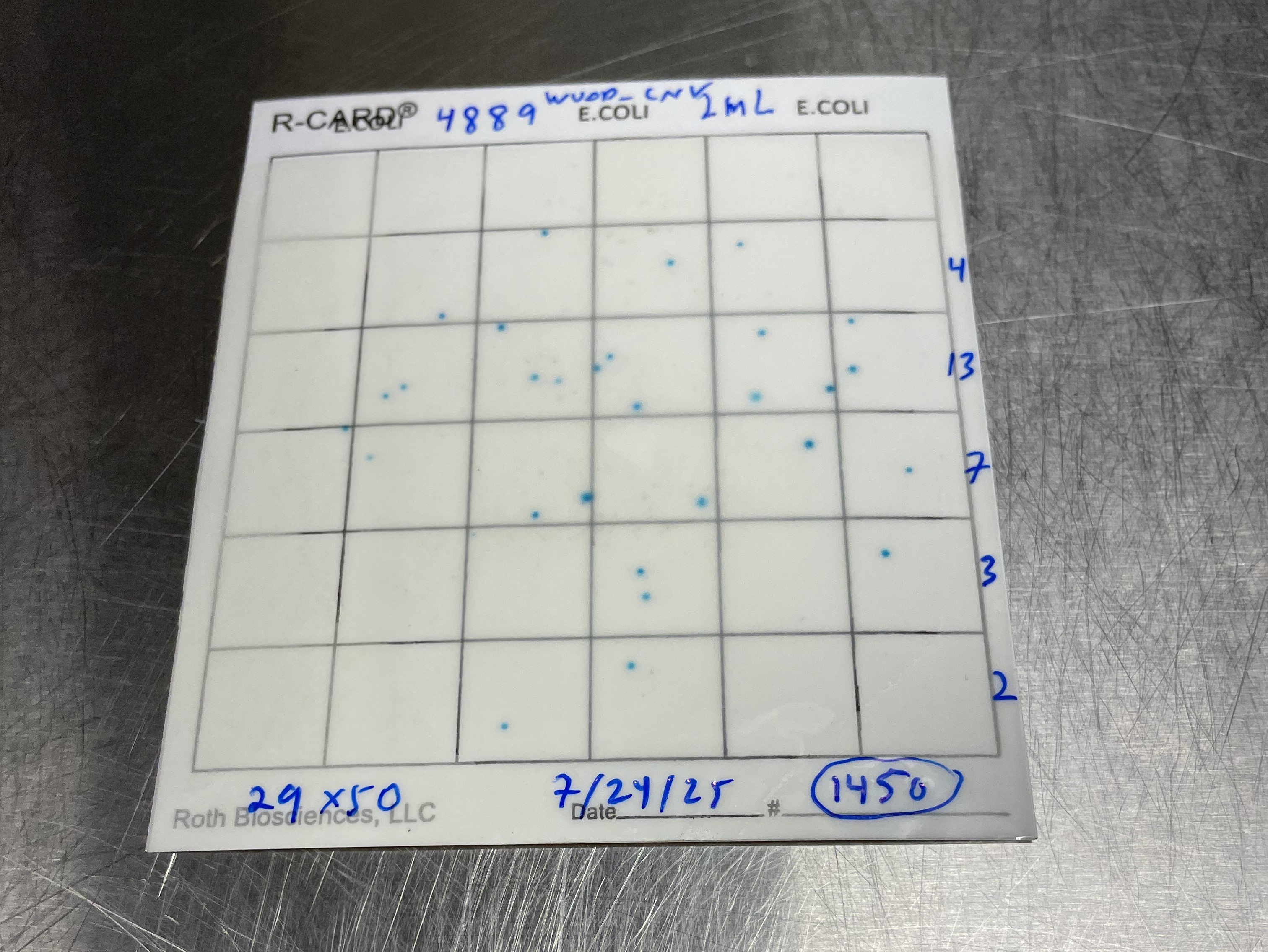

Before (left) and after (right): R-Cards are simple tests used to quickly estimate the amount of E. coli bacteria (an indicator of poop pollution) in a water sample. Before the repair, high levels of E. coli are visible as small blue dots on the R-Card. After the repair, the R-Cards show bacteria was nearly undetectable with nearly no blue dots!
Partners and Funders
Caring for King County’s water is a shared responsibility. Targeted actions like these happening around Poverty Bay require significant coordination between many dedicated people and agencies who make water cleaner for all of us. We’re grateful for our partners on the Woodmont Creek repair PIC project:
- City of Des Moines
- King County’s Department of Natural Resources and Parks, which includes the Science Section, Stormwater Services, and the King County Environmental Laboratory
- Public Health— Seattle & King County
- PIC Work Group
- Puyallup Tribe of Indians
- Midway Sewer District
- Residents and property owners
- Washington State Department of Ecology
- Washington State Department of Health
- United States Environmental Protection Agency National Estuary Program
We also thank our federal partners in this work. This project has been funded wholly or in part by the United States Environmental Protection Agency under assistance agreement PC-01J89801-1 to the Washington State Department of Health. The contents of this document do not necessarily reflect the views and policies of the Environmental Protection Agency, nor does mention of trade names or commercial products constitute endorsement or recommendation for use.
More information: