A cold April rain fell on the Green River but the research carried on. Chris Gregersen and Dan Lantz, ecologists from King County’s Science Section, floated down the river’s mainstem and poked into its tributaries listening for loud, electronic beeps from their tracking antennas. Each beep meant a juvenile Chinook salmon (Oncorhynchus tshawytscha) – previously tagged by our team or other researchers – was swimming below. Every beep was a reason to celebrate, especially in weather like this.
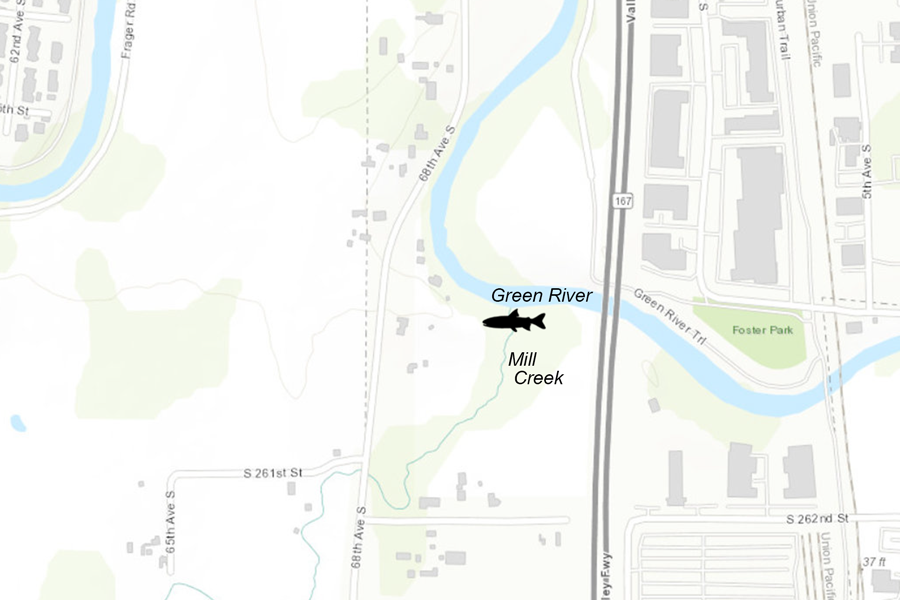
Then as they paddled up Kent’s Mill Creek in search of more Chinook, Chris and Dan noticed something strange in the water. On both sides of their small craft, distressed coho salmon (Oncorhynchus kisutch) were floating, circling, and flopping on their sides near the surface. The ecologists immediately recognized this behavior as a possible symptom of urban runoff mortality syndrome (URMS). This tragic cause of death is not uncommon for adult coho spawners in urban waterways polluted by the toxic tire chemical 6PPD-quinone (6PPDQ).
…But Mill Creek was not a documented hotspot for URMS deaths, and these fish were not adults. So, what was killing the juvenile coho in Mill Creek?
(Jump to video captured by our ecologists)
This sad discovery is among the earliest documented cases of juvenile coho – rather than spawning adults – dying from urban stormwater runoff in their natural environment. The evidence collected contributes to a rapidly growing body of research on 6PPDQ, its effects on coho salmon, and how to protect young fish heading to Puget Sound and adults returning home.
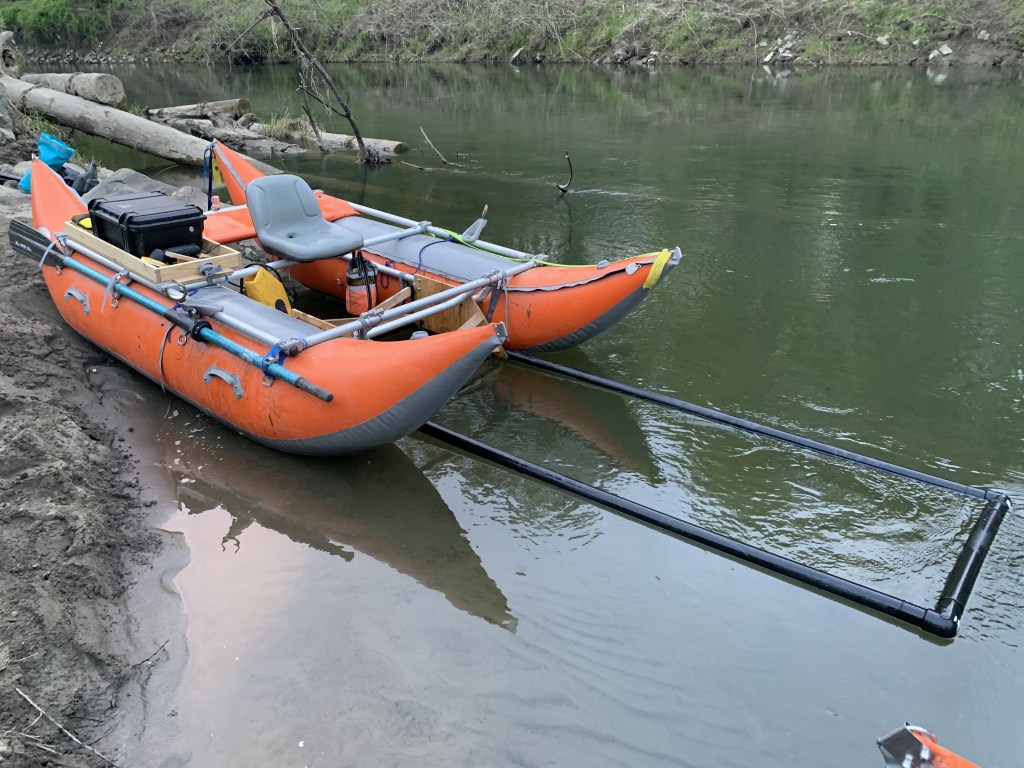
A bridge between the lab and the real world
Laboratory studies tell us that young coho, like adults, are extremely sensitive to 6PPDQ, the toxic tire chemical that causes URMS. Juvenile fish in these studies show the same physical symptoms to 6PPDQ exposure as adults and appear to be even more susceptible at certain points in their development.
Earlier this year, a team of researchers from the University of Washington (UW), Washington State University (WSU), and United States Geologic Survey (USGS) published findings from an exposure study using real-time water from nearby Miller Creek. Their study showed that stream conditions during spring storms killed ~80% of juvenile coho that were exposed to the stream water.
The small struggling salmon in Mill Creek seemed to be an important bridge between laboratory observations and the real world, but only additional testing could confirm whether 6PPDQ was responsible.
Coordinating to find a killer
After Chris and Dan captured video footage of the strange event, a cascade of alerts went out. King County’s ecotoxicology team and WRIA 9 Technical Coordinator Iris Kemp quickly notified regional jurisdictions and partners in salmon recovery and 6PPDQ research. City of Kent Public Works Environmental staff, Senior Biologist Christina Neff and Environmental Specialist Ben Saari, also observed the event further upstream in Mill Creek at the Leber Backchannel and reported it to the Washington State Department of Ecology (Ecology) and WRIA 9 staff.
Within hours, teams from WRIA 9, WSU, and Ecology were at Mill Creek collecting evidence for laboratory testing.
Our suspicions were confirmed when recent tests at UW Tacoma’s Center for Urban Waters found toxic levels of 6PPDQ in tissue samples from these coho. More samples will be analyzed by chemists at the King County Environmental Lab in the coming months, adding even more data to the case.

Bad timing for the fish, rare timing for the researchers
At this time of year, it’s normal to find natural- and hatchery-origin coho in streams and rivers, eating to grow as much as possible before they migrate downstream and into Puget Sound.
Though rarely recorded, juvenile die-offs like this could be fairly common in urban streams during rainy spring weather. It’s hard to spot small fish, especially when storms increase stream flows and turbidity and make field work more dangerous. Researchers rarely conduct visual fish surveys in those conditions and could have missed past juvenile URMS events as a result.
But Chris and Dan were using tracking antennas to find Chinook. Even in dark, murky water, the microchip in a tagged fish will ping sensors when it gets close enough, whether anyone actually sees the fish or not. This means researchers can go out rain or shine, day or night, and are more likely to discover an event like the one at Mill Creek. The distinct behavior of the dying coho wriggling frantically at the water’s surface also made them easier than usual to see and photograph that day.
(Jump to video captured by our ecologists)
More data on juvenile coho and 6PPDQ
The documentation and resulting data from this event add important information to an urgent and expanding body of research. Many regional scientists are exploring how, where, and when 6PPDQ impacts coho and other fish.
In addition to the stream-side exposure study at Miller Creek, WSU’s Aquatic Toxicology Lab and UW’s Center for Urban Waters recently published findings on how 6PPDQ exposure impacts coho at different life stages.
And here at King County, we’re looking for the best ways to monitor, mitigate, and eliminate 6PPDQ. Our work includes studies on the effectiveness of special soil mixes in the lab and the real world, as well as testing new uses for existing technology.
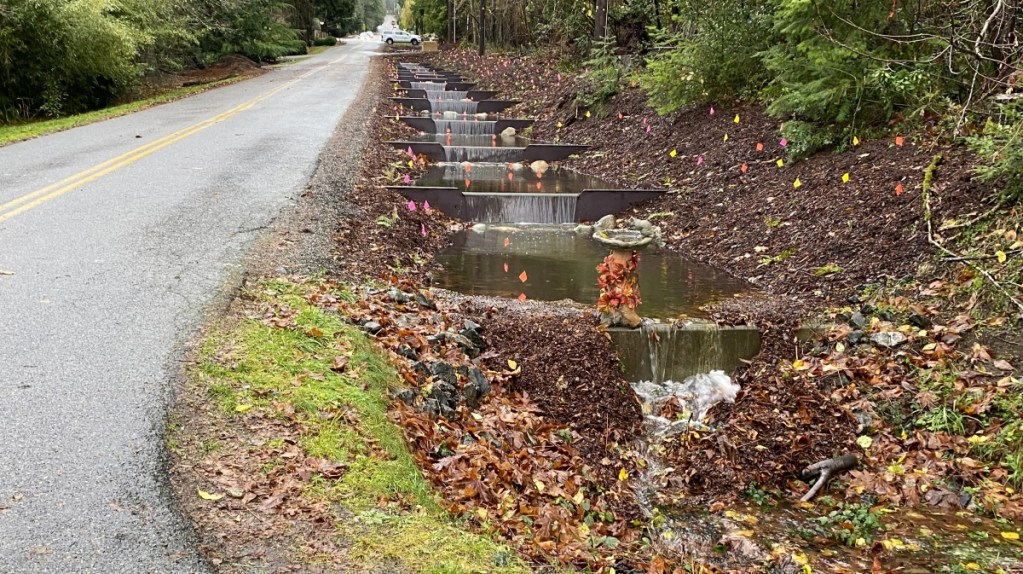
Taking action with passive samplers
It’s hard to track 6PPDQ in real time. The chemical peaks in urban streams during storm events and quickly drops back to levels that are hard to detect. Even then, trace amounts can harm coho and other sensitive species.
To get a fuller picture of 6PPDQ in King County streams, we’ve partnered with Ecology, USGS, and Trout Unlimited to experiment with devices called passive samplers. These small instruments sit in one location for weeks or months and document the presence and the relative amounts of 6PPDQ in streams across time. Understanding when and where we see high 6PPDQ levels in streams can help us find hot spots, sources, and solutions.
Early results of this approach are promising and suggest that passive monitors are a reliable, cost-effective way to track 6PPDQ. Recently, the Science Section’s Chelsea Mitchell and Ecology’s Rhea Smith shared these findings at the Annual Meeting of PNW SETAC, the regional chapter of the Society of Environmental Toxicology and Chemistry. Jeremy Walls, who leads the Science Section’s stream water quality monitoring program, also shared the project at the 2026 Annual Meeting of the Society for Freshwater Science.


Ecotoxicologist Chelsea Mitchell deploys a passive sampler called a polar organic chemical integrative sampler or POCIS. On the right, a POCIS sits inside a wire cage that protects it from stream debris
Research readiness and reporting
Our researchers aren’t eager to see another case of juvenile coho URMS. But if they do, they’ll be ready to collect real-time water and fish samples and rapidly connect with partners once again. Adding Mill Creek to a map of known URMS locations will inform our monitoring efforts and help us better understand where and how salmon are struggling to survive in urban waterways.
Being out and about in all conditions and communities helps King County find and respond to problems quickly, but we can’t be everywhere all the time. We need your help to find and fix problems!
Report flooding, drainage, or water quality problems in unincorporated King County with this online report form or by calling 206-477-4811. If the problem is within a city area, visit our city referrals page to find contact information for that city. You can also report a suspected spill to the Washington State Department of Ecology.
Video of juvenile coho affected by toxic levels of 6PPDQ
We’re sharing video from our ecologists to show what juvenile coho affected by 6PDDQ can look like in the wild. We hope it is useful to other institutions and people who spend time on or near urban streams. Please contact us with any questions!
Note: The short video below shows distressed and dying fish.
Audio narration begins at 12 seconds.
Links and Resources
- VIDEO: King County scientists identify a potential breakthrough for treating salmon-killing tire chemical | King County
- Report flooding, draining, or water quality problems in unincorporated King County
- Find contact information for problems within a city
- Report a suspected spill to the Washington State Department of Ecology