This spring, scientists from the Science Section’s Watershed and Ecological Assessment Team (WEAT) went looking for juvenile Chinook salmon (Oncorhynchus tshawytscha) in streams where they have not been previously documented. The team spent 29 days in the field, ultimately completing 97 surveys across 20 different streams.
Studies like this are time sensitive: the right fish are only in the right places at the right time and even then, they’re very hard to find. To make the best use of small timeframe, agencies like ours rely on seasonal support from early career professionals like Lauren Hodges (jump to Lauren’s bio).
After 26 days of wading, zapping, netting, and measuring, we asked Lauren to share a day in the life of a field biologist looking for small salmon in surprising places.
A day in the life of a field biologist
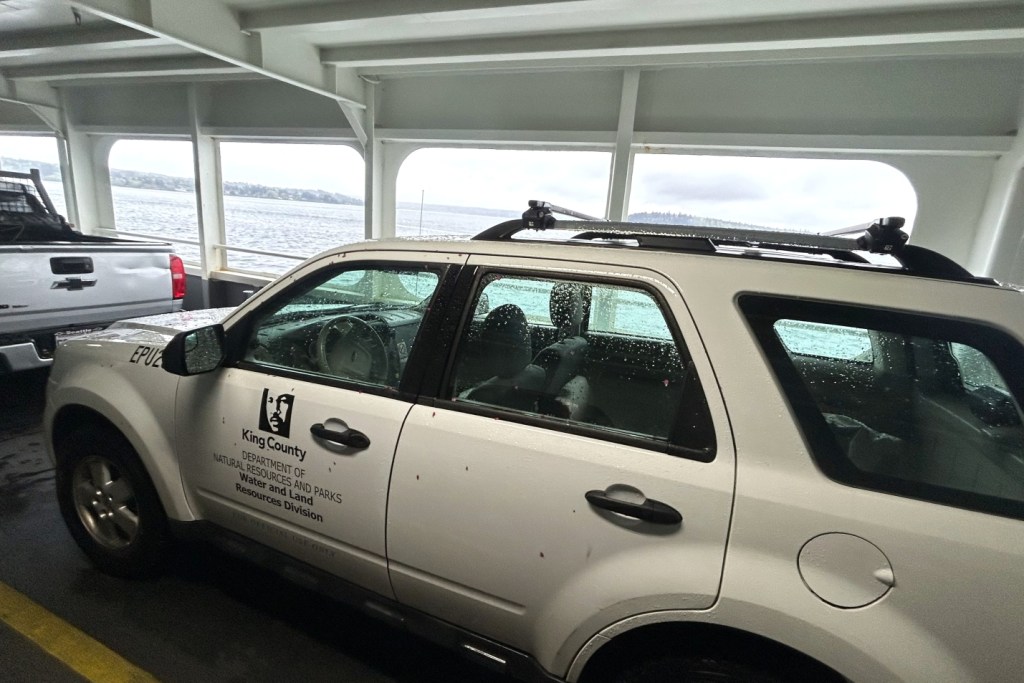
Taking the ferry to work
It’s an overcast, slightly rainy day and I’m still waking up as we wait for the ferry from Fauntleroy to Vashon Island. Aaron David (the biologist leading this study) and I catch up about our weekends and chat with Kollin Higgins, another biologist on our team who is helping us today.
Once the truck is parked, I make my way up to the passenger deck hoping to find the puzzle I’ve been working on for the last few weeks. It’s another day of sampling for Aaron’s non-natal streams study and I sit by the window looking out at Puget Sound, thinking of the Chinook salmon I hope to see today.
After a few minutes, the boat captain comes on the speaker signaling the end of our ferry ride and I make my way back down to the car level to prepare for a day in the stream.
The non-natal streams study and why it matters for juvenile Chinook salmon
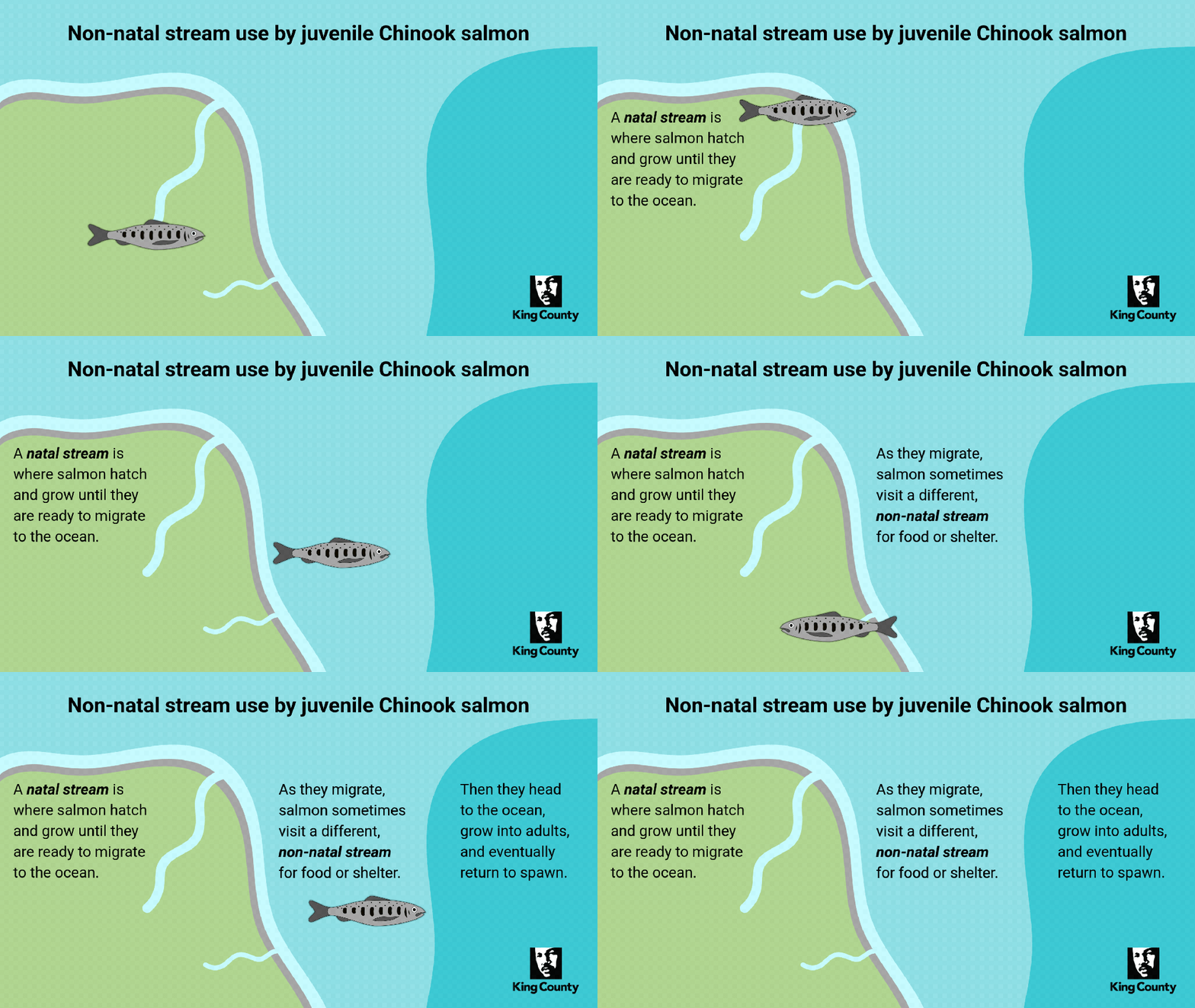
In the typical life history of Chinook salmon, adults spend several years in the ocean before they migrate back to the river or stream where they were born. There, females lay thousands of eggs in gravel nests, or redds. Once they hatch, juvenile salmon eat and grow in their home river or stream before they migrate downstream to the ocean. Then the whole cycle begins again.
Chinook are the largest salmon species in our region and adults need bigger streams and rivers to spawn, which is where scientists commonly find newly hatched and growing juveniles. But sometimes scientists also find young Chinook salmon in streams that are too small for spawning and separate from watersheds with known Chinook salmon spawning.
These observations suggest that some juvenile Chinook leave their home watersheds and migrate towards the sea, then decide they aren’t ready for the ocean and return to different small freshwater streams. This detour, called non-natal stream use or non-natal rearing, is the phenomenon we’re looking for in this study.
We are hoping to understand how common non-natal rearing is for Chinook in central Puget Sound and identify streams that support non-natal rearing. This information can help King County and other organizations working to recover salmon populations prioritize streams for conservation and habitat restoration.
Our team is surveying a total of 20 streams: 10 on the mainland and 10 on Vashon Island. We plan to sample each stream five times for a total of 100 surveys. We have our work cut out for us.
Surveying Shinglemill Creek
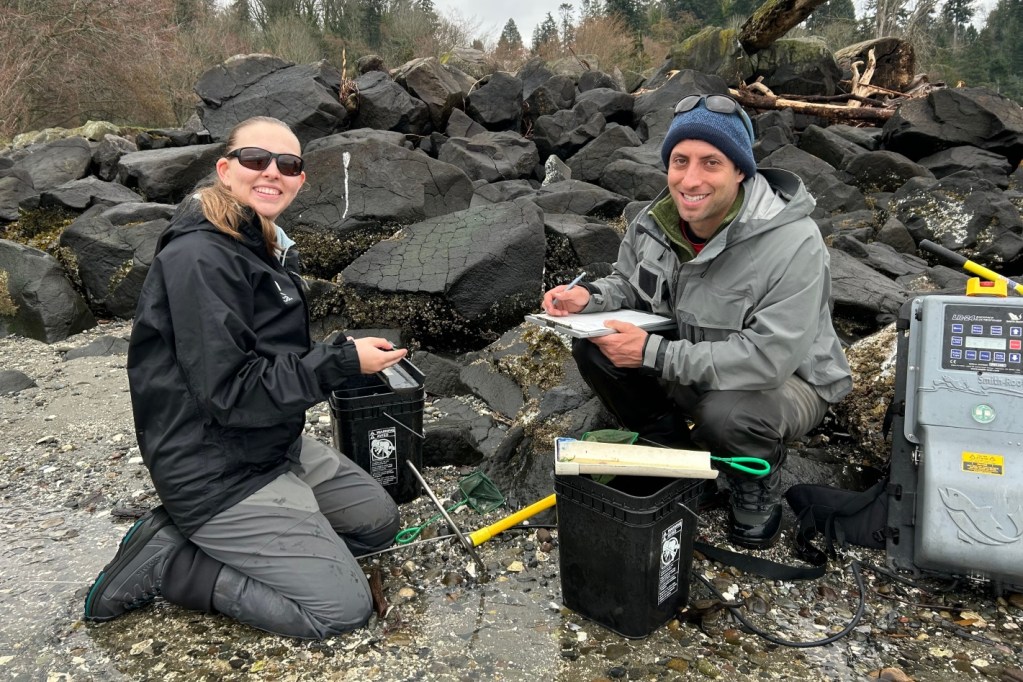
After our short ferry ride, we drive to the first stream of the day, Shinglemill Creek. We grab our gear out of the truck, including buckets, nets, and a fish-shocking backpack called an electrofisher, then hike down to the beach to meet our collaborators.
The Vashon Nature Center has been working with us to collect genetic information on salmon that we find, including non-Chinook species. They were also integral in connecting us with landowners on the island before our surveys began. Without the teamwork between the Vashon Nature Center and landowners allowing us to sample on their property, this project would not have been possible.
We’re also working with scientists from the University of Washington who are sampling potential chemical contaminants from the streams to better understand what’s influencing the presence of fish in different locations.
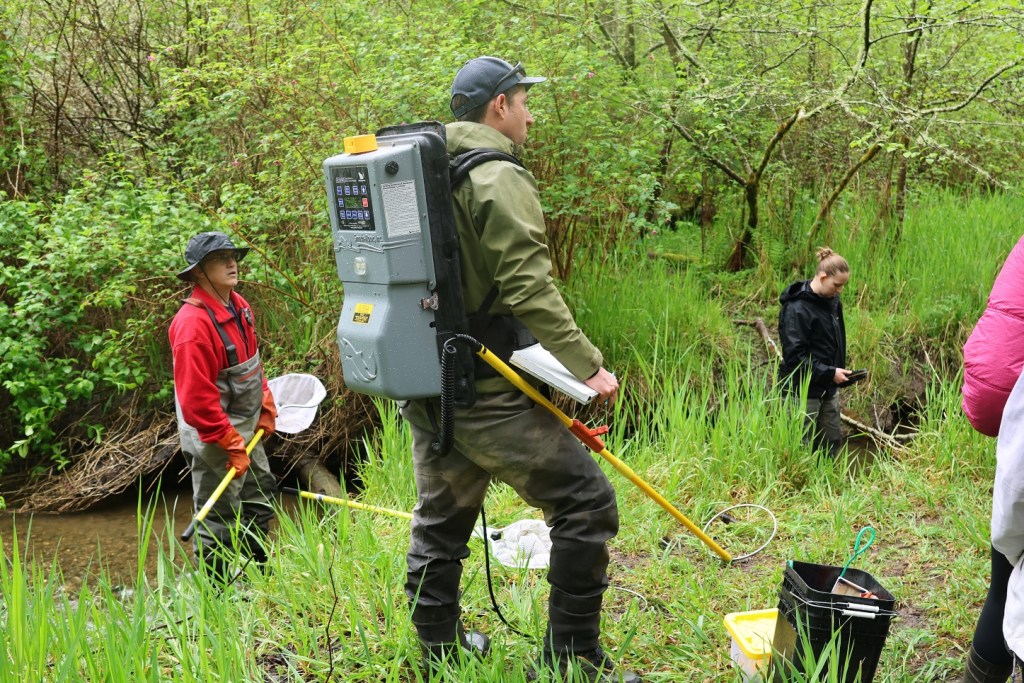
Aaron (center) wears the electrofisher, a backpack that sends an electric current down a pole into the water to stun nearby fish. Lauren (right) collects temperature and conductivity measurements in the stream while Kollin (left) waits at the ready.
Sampling the intertidal reach
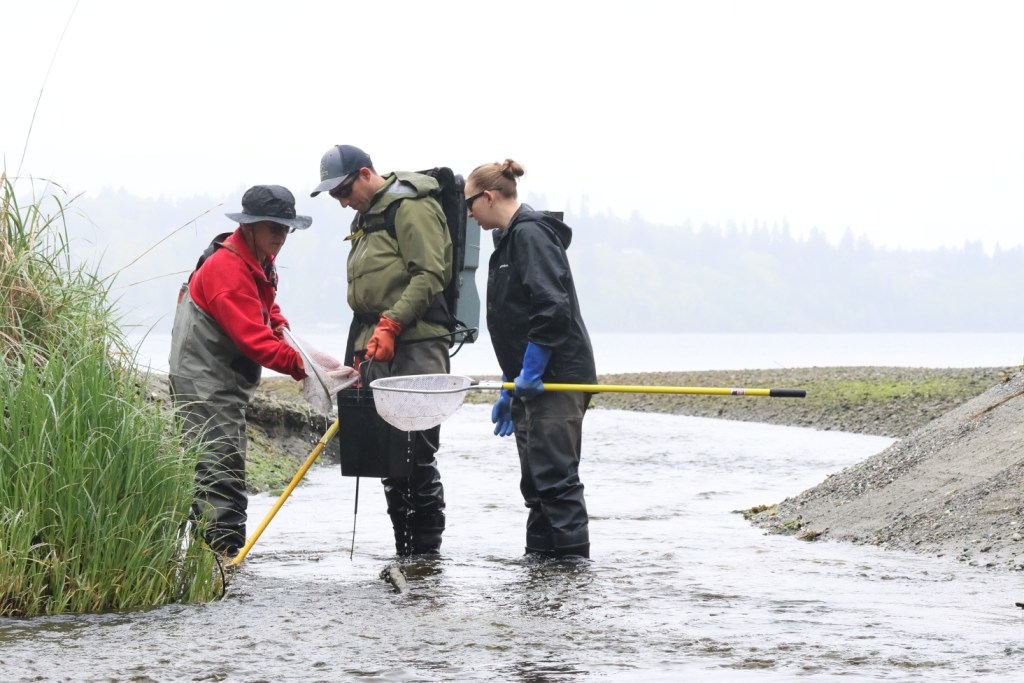
Each of our streams has two main reaches, or stretches, that we survey. There is an intertidal reach on the beach where the stream flows into Puget Sound, and an upstream reach that extends between 60 and 100 meters above the beach. Tides and weather determine where we start and today it’s the intertidal reach. While Aaron suits up with the backpack, I get a quick temperature and conductivity reading. This information helps us determine the best settings for the electrofisher so that we can stun the fish but not hurt them.
I’ve got my gloves on and net in hand, ready to catch some fish.
When a fish is stunned, all you can see is a quick flash of silver in the water. When we see the flash, we have to quickly net the fish before it floats past us or recovers and swims away. It feels sort of like an outdoor arcade game.
Aaron walks in the stream moving the softly beeping electrofisher through the water and along the banks. Kollin and I follow behind him scooping up silver flashes and putting the fish in a bucket of stream water until we get to the top of the intertidal reach. Now it’s time to measure and tally our catch. (Jump to fish photos)

Our intertidal finds
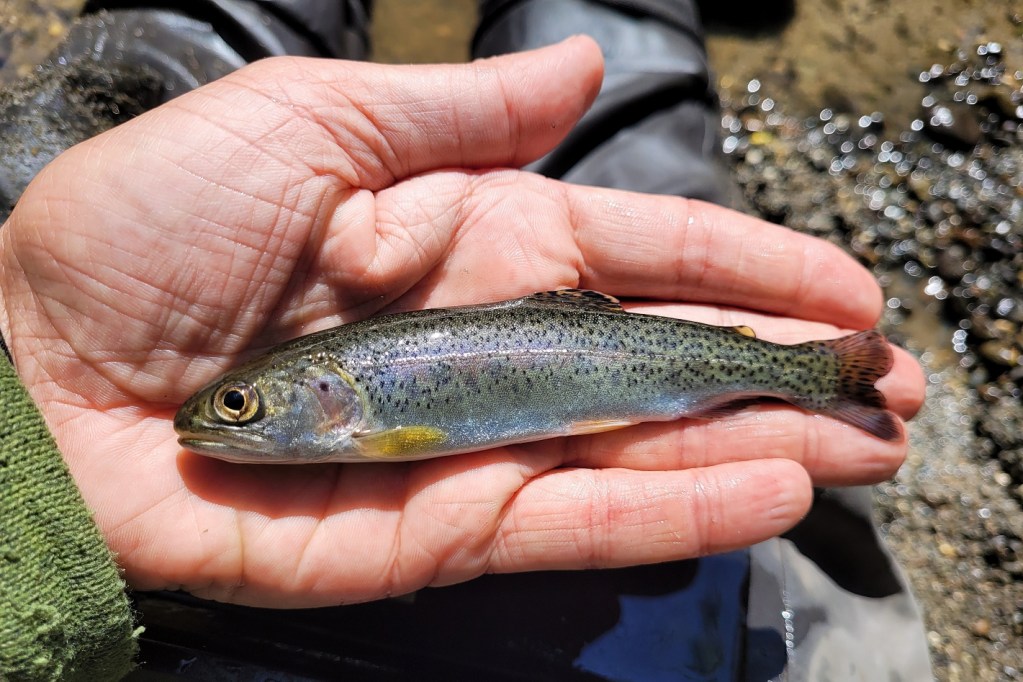
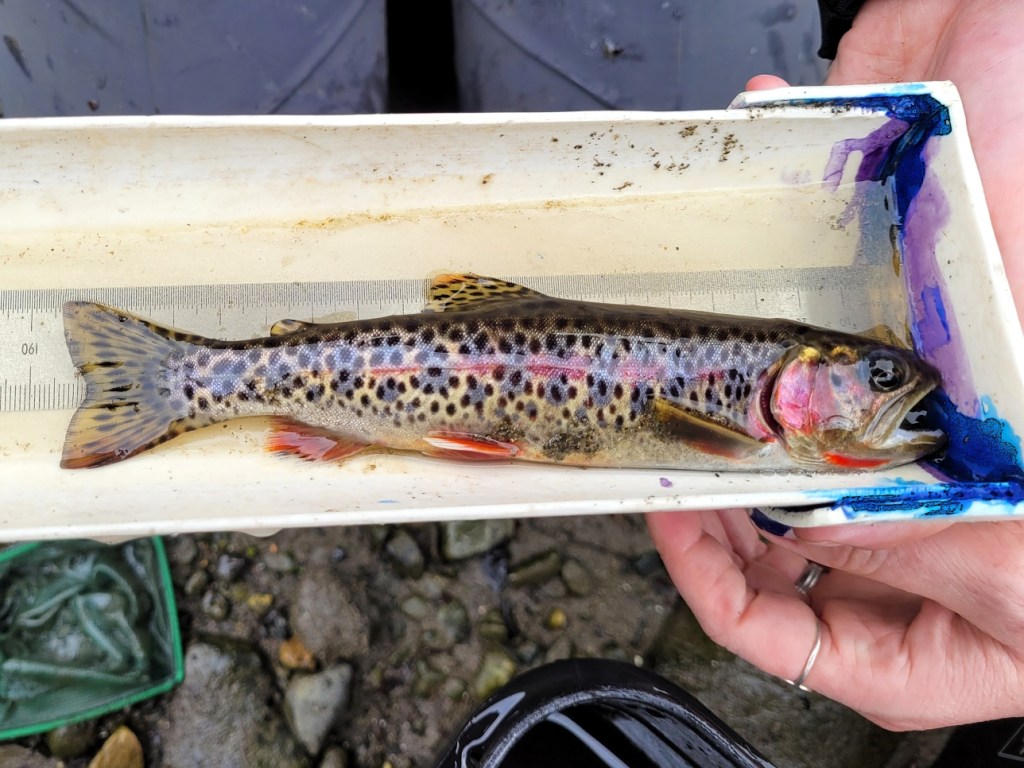
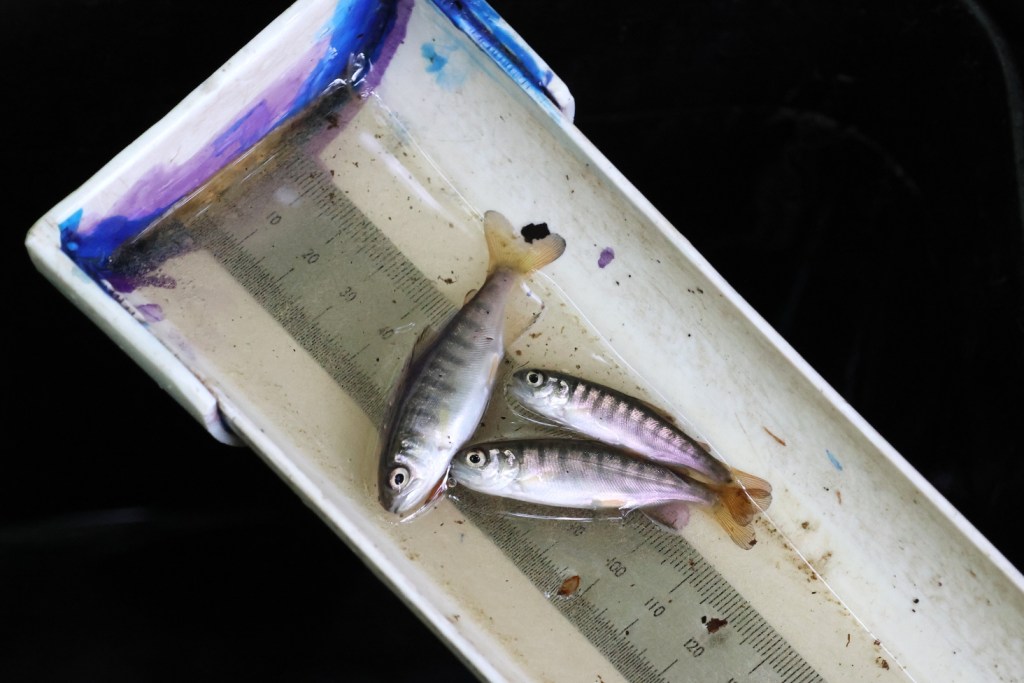
Today, we got quite a few cutthroat trout (Oncorhynchus clarkii), some Pacific staghorn sculpins (Leptocottus armatus), a prickly sculpin (Cottus asper), and two coho salmon (Oncorhynchus kisutch). It’s hard to say which fish is my favorite of the bunch. Cutthroat trout have beautifully vibrant coloring. However, I have a soft spot for prickly sculpin; their smushed faces remind me of bulldogs. (Jump to fish photos)
After we’ve measured all the fish, Aaron collects genetic samples from a few cutthroat trout and coho salmon for the Vashon Nature Center. He takes small scissors and cuts a tiny piece of tissue from their tails. The sample will be sent to a lab and analyzed to learn what population these fish are from.
Now that we collected all the data we need, I slowly tip the bucket into the creek so the fish can swim back to their hiding spots. We move on to our next reach.
Sampling the upstream reach
Just upstream of the intertidal reach, we get to the start of our next reach, where I take another temperature and conductivity reading. Once again, Aaron shrugs on the backpack, and Kollin and I stand at the ready.
The upstream reaches tend to be a bit more difficult than the intertidal. The stream channel twists and turns, there are undercut banks and plants that fish hide in, and we have to navigate logs and branches in the stream. While all of this is somewhat inconvenient for sampling, it means there is excellent habitat for young fish to hide.
When we get to the end of our upstream reach, we check out the new fish in our bucket. Lengths are measured, genetic samples are taken, and the fish are released back to the stream. We pack up our gear and hike back to the truck to drive over to our next stream and do it all over again.


The first juvenile Chinook of our non-natal streams survey
We didn’t find any Chinook today, but I still remember the first one we caught earlier in the study.
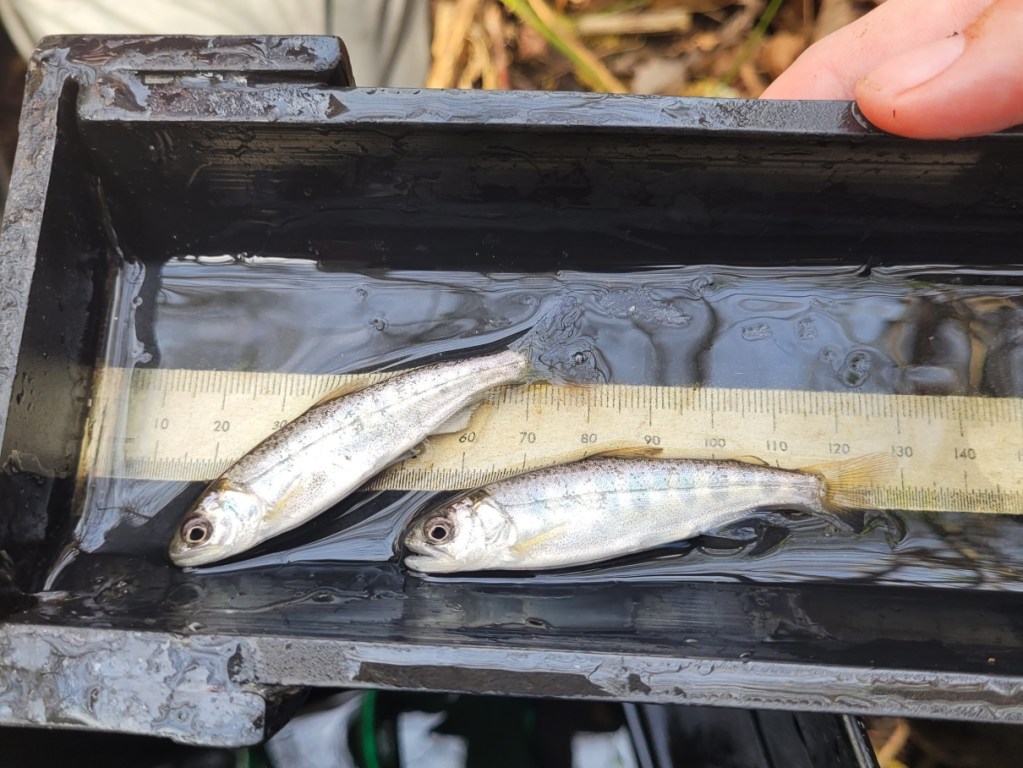
It was our second time sampling a mainland stream called Lakota Creek near Federal Way. It was like any other survey until we moved one fish from the net to the bucket and Aaron said, “I think that is a Chinook!”
Some of the coho look very similar to Chinook so we were cautiously excited but couldn’t stop yet to double check. Once we finished the reach and set the bucket on the bank, it was the first fish we looked at.
And Aaron was right: we had caught a Chinook. In fact, we caught two!
Everyone was excited, and it felt like there was a little bit of relief, too. The study was showing us what we thought it would: juvenile Chinook salmon are indeed using some of these non-natal streams.
What days like this mean
After our long day of sampling, we’re back on the ferry to the mainland. My feet and knees ache a bit, but I feel contently tired after a day in the field.
These surveys are only the beginning of the project. Aaron still has to sort through the data collected by our team and our project partners, the Suqamish Tribe and the Tulalip Tribes, to figure out what it all means.
We found a total of nine juvenile Chinook in six different non-natal streams, so we do know that Chinook salmon use some of these areas. We were hoping to find more, but unfortunately this wasn’t an ideal year for studying. The floods last winter destroyed many Chinook redds, so there were far fewer juvenile fish migrating out this year than normal.
As someone in the beginning of their career, the opportunity to work on this project has been incredibly valuable. I feel very lucky to be part of a study that will help inform restoration projects to help Chinook populations.
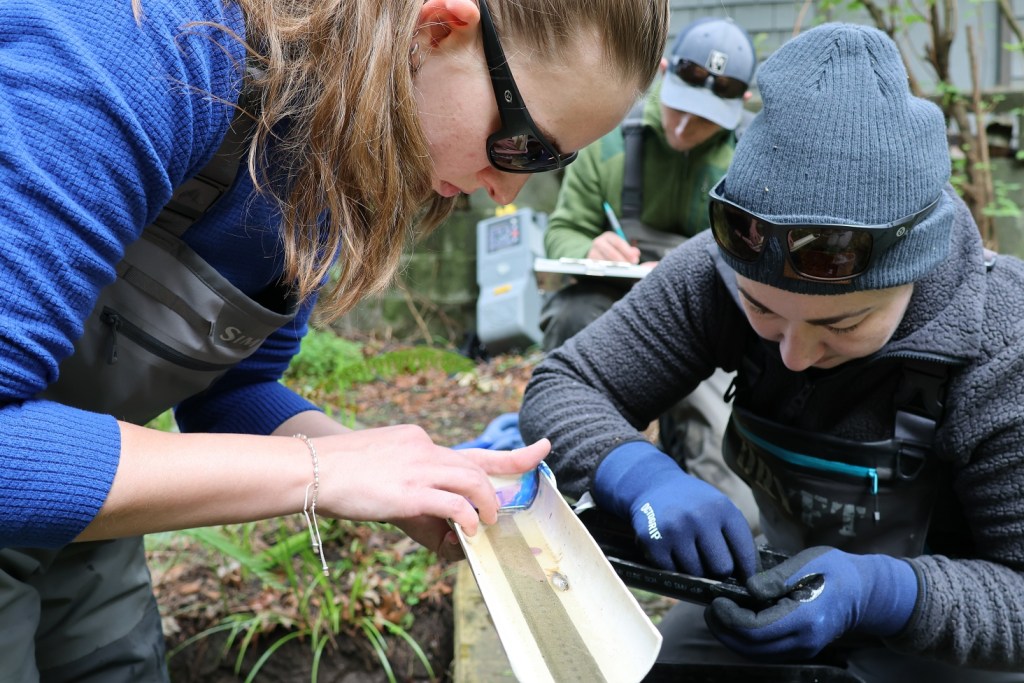
Lauren (left) and WRIA 9 Technical Coordinator Iris Kemp (right) measure fish in West Seattle’s Fauntleroy Creek as Aaron records data
Partners and funders for this study on juvenile Chinook salmon use of non-natal streams
This non-natal study is a collaboration between the King County Water and Land Resources Division, the Suquamish Tribe Fisheries Department, and the Tulalip Tribes Natural Resources Department, with additional collaboration with the Washington Department of Fish and Wildlife Molecular Genetics Laboratory.
This study is supported by two grants. One is a Cooperative Watershed Management (CWM) grant from the WRIA 9 Watershed Ecosystem Forum. CWM grants are funded by the King County Flood Control District.
The second grant is a learning program/pre-design grant from the Estuary and Salmon Restoration Program (ESRP). This ESRP grant is funded by Washington’s Climate Commitment Act (CCA). The CCA supports Washington’s climate action efforts by putting cap-and-invest dollars to work reducing climate pollution, creating jobs, and improving public health.
Other fish we found
We saw a lot of the same species while sampling, and it became fairly easy to anticipate what we were going to see in each stream. But occasionally, we caught something that took me by surprise.
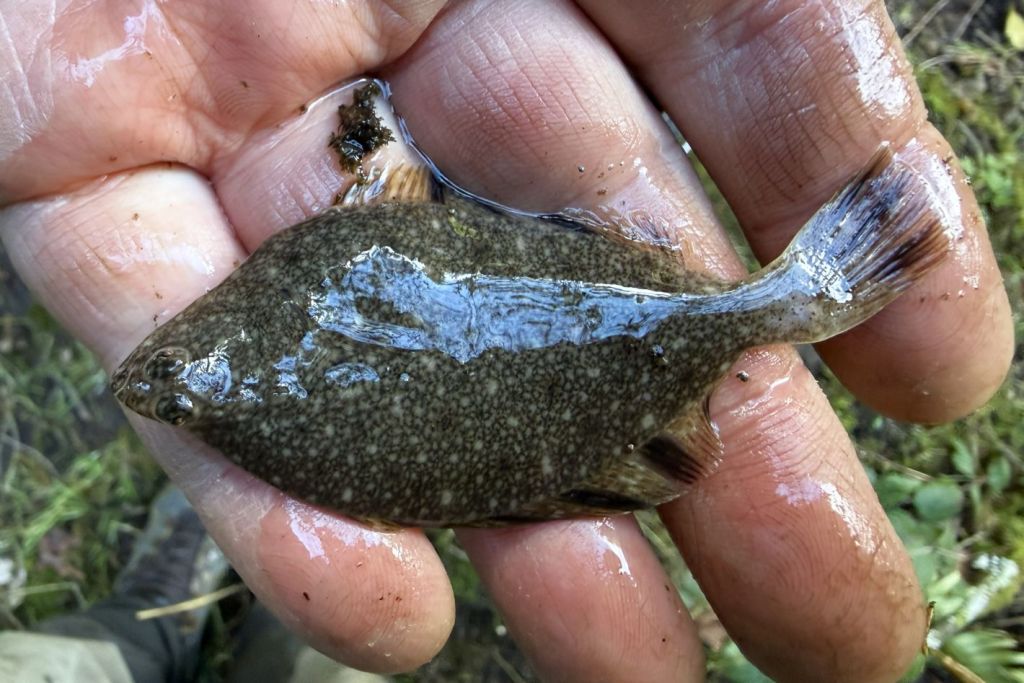
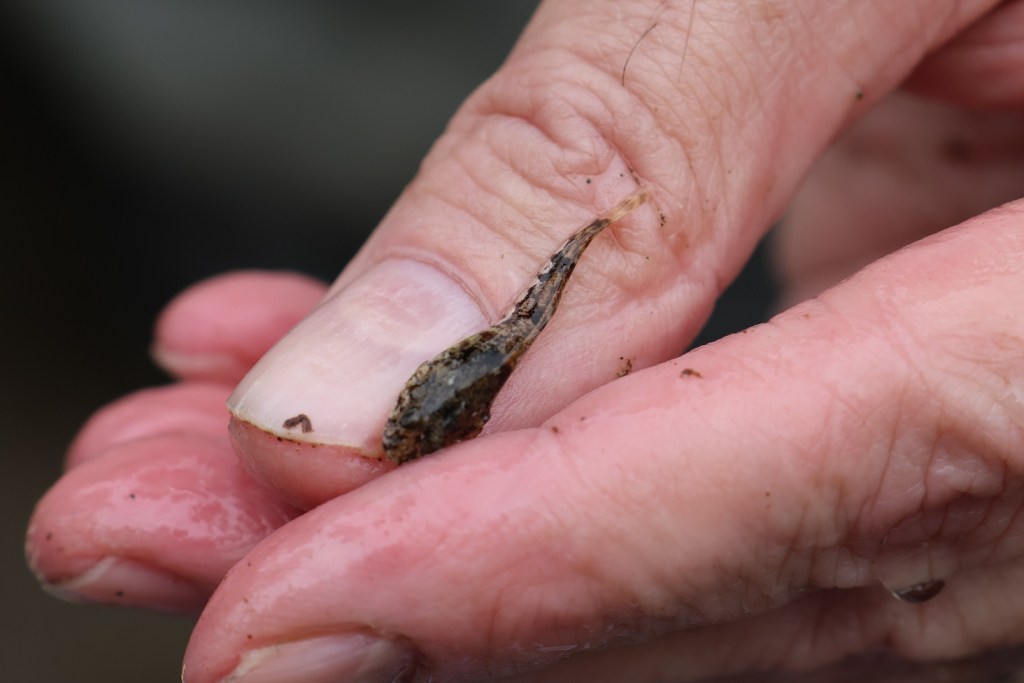
The most interesting fish we caught were flounder, a saltwater fish. Once I thought I’d accidentally caught a leaf in my net. To my surprise, it was a tiny starry flounder (Platichthys stellatus). These are such interesting fish to look at up close! Both eyes are on one side of their body, and the other side is nearly translucent.
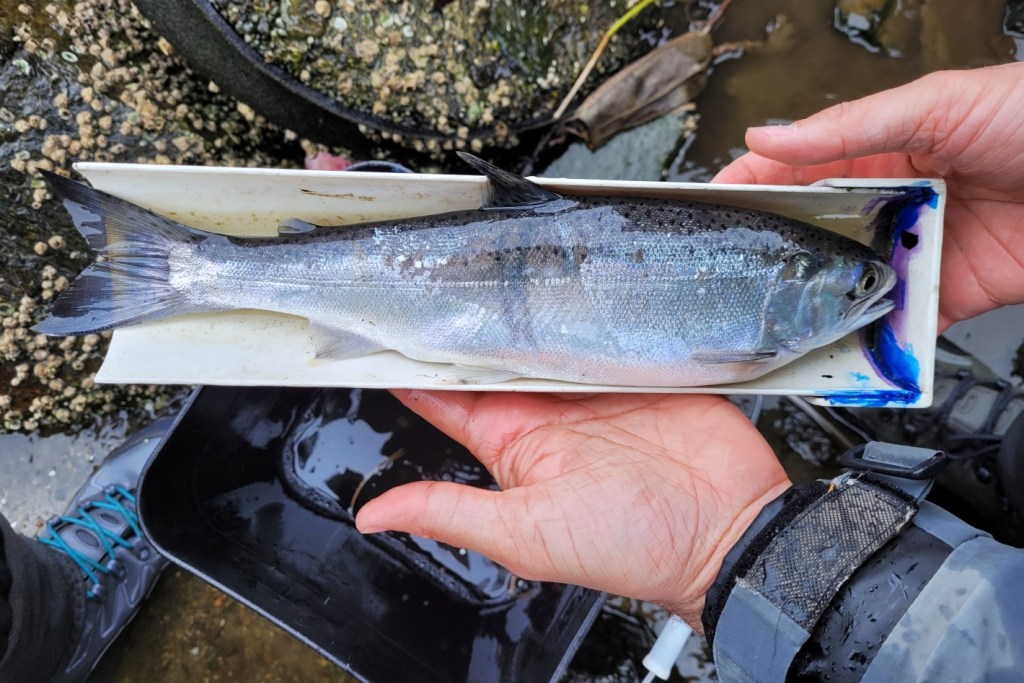
Some of our more frequent fish finds included coastal cutthroat trout, juvenile coho salmon, and several types of sculpins. (Note: The fish pictured below were quickly measured, documented, and released.)


Author bio
Lauren Hodges is an early-career biologist with a focus in fisheries and aquatic ecology. She served as an Environmental Aide in the Science Section’s Watershed and Ecological Assessment Team (WEAT), assisting with fieldwork on multiple projects at the County. When she’s not working, Lauren likes to spend as much time as she can outside, ideally near or in a body of water.
Links and Resources:
- More details and references for this study | Salish Sea Wiki
- ‘Salmon SEEson’ turns 20: Spot fish coming home to spawn in King County rivers and streams | DNRP Field Notes
- WRIA 9 Watershed Ecosystem Forum
- Washington Climate Action
- Fish and shellfish in King County | KingCounty.gov